Once upon a time there was a princess called Tanya, who lived in a
very, very, very big castle. The princess’s
parents, that is to say, the king
and queen, wanted her to marry a handsome knight called Norman, who
would often visit them to discuss the land they shared, so Tanya and Norman saw
plenty of each other.
Unfortunately Tanya didn’t love him. Although they got on well enough, she
didn’t much like him, for Norman was
very boastful.
One day, Tanya
the princess was talking to Norman about the new decorations the king
and queen were going to make in the castle, when suddenly Norman changed the
subject and said: “Tanya, I like you a
lot. In fact, I want to spend the rest of my life with you.”
The princess was shocked but instead of firm “NO“, she said: “Norman, you’re a very
handsome knight, but I like to be honest with people. So I’m going to tell you
what I don’t like about you, which is this: firstly, you’re a show-off, because
you like boasting about the clothes you wear when really a person’s clothes
aren’t that important; secondly, you spit in the street which is disgusting,
and lastly, I’m not going to marry you just because my parents tell me to: I’m going to marry a man I really love.”
Norman reflected long and
hard on what the princess had said. To begin with, he
felt bad about her opinion of him, but he soon cheered up when he realised that
all the things she mentioned were things he could change. It wasn’t his
personality that annoyed her, but his behaviour.
So Norman began trying not to brag about his clothes,
and started to feel happy in more modest clothing. He also learned not to spit
in the street so as not to look horrible and coarse, and he felt better about
that, too. And finally, he went to talk to the king and queen to ask them not
to talk to the princess Tanya about him, and that way she wouldn’t feel
pressured into marrying him.
Tanya and Norman continued spending time together and
gradually Tanya began to notice the
change in his habits. Seeing that he no longer did horrible things, she
also began to notice other details about him, and to like him.
Eventually the
princess fell in love and married him.
So you see how the princess’s honesty gave the knight the chance to think and change
a few little things that had upset her. Honesty
helps people find solutions to lots of problems.
THE END
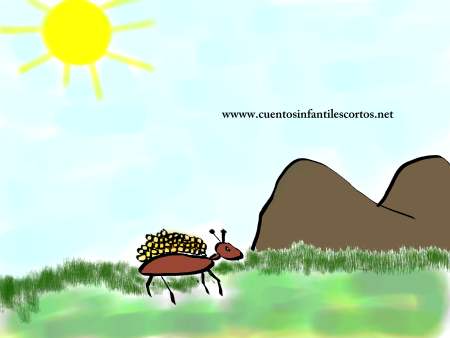
Once upon a time there was a little ant called Anita.
She was very hard-working and
lived in an anthill with the rest of her family – about 50,000 relatives.
The ants were busy storing
the grain for the winter so that
when the cold weather came there would be enough food for everyone. But this
year, the grain was very small and difficult to transport. It was a gloomy
situation and even the wisest old ants weren’t sure they could survive the
winter.
But Anita
wanted to store as much grain as possible to help her family, and she
knew that by showing an optimistic attitude around the rest of the ants, they
could do it. So off she went to train with an ant who was much stronger
than her, an ant called Alexander.
Alexander taught her a few tricks on how to carry more grain with the same amount of
effort. Anita trained for a few days and as the days went past, she was
able to carry more and more.
When Anita was finally ready, she called the rest of
the ants together and told them: “I know you think we won’t survive the
winter. But I have a solution:
firstly, you have to believe we can do it, and secondly, I’ll teach you what
you need to do to carry more grain.”
And so the
whole anthill set to work like Anita said, with optimism and a hopeful heart, and before the winter arrived they
had already gathered more grain than the year before. And so it was that,
thanks to Anita, all the ants survived the winter without any problem.
THE END
Princess
Isabella
Princess Isabella, a short story by LJ Kundananji
Once upon a time, in a far, far away land, there lived
a very beautiful princess by the name of Isabella. She was very beautiful and
had long, golden hair. She lived in a beautiful castle whose walls were made of
gold, and nothing but beautiful, shiny gold. The moat was full of water that
was so clear you could see the beautiful gold fish gracefully swimming in it.
People came from all over the world came to admire this beautiful castle, the
beautiful gold fish that swam in its moat, and the beautiful princess that
lived in it.
Isabella was not only beautiful, but she also had a
very good heart. She was kind to everyone, especially the poor and needy. For
this reason, she was dearly loved by all. It seems she took after her father
who was also very kind and generous to his subjects. However, her mother, the
queen, was very wicked at heart. She was unkind to everyone and treated her
subjects very badly. As a result no one in the kingdom loved her.
In time, the queen noticed that her daughter was more
loved than she was and that she had lost the favor of all her subjects. In
addition, her daughter was more beautiful than her and was becoming more and
more beautiful by the day. This filled the queen with a great, deadly rage and
she began to despise her own daughter. Her hatred for Isabella grew so big that
one day, she decided to get rid of her.
Isabella happened to be walking in the gardens of the
castle, admiring the beautiful, green trees and the beautiful flowers and
talking to the gold fish that swam lazily in the ponds, when suddenly the
guards who guarded her turned upon her, seized her and muffled her up with an
old, dirty rag. She fought furiously to break free but they were too strong.
They quickly bound her and threw her into a carriage that stood waiting nearby
and drove out of the castle, the horses that drew the carriage galloping off at
a furious speed. So that she could not see where she was being taken, a sack
was thrust over her head.
After ascertaining that her dastardly deed had been
carried out, the queen ran to see the king. She fell upon her knees before him,
shading floods of tears and wailing on the top of her voice.
“My King!” she cried, “a bad, evil deed has been
done!”
“What say you?” the king demanded, surprised and
shocked.
“Your enemy, King Flatfeet, has kidnapped your
daughter and hid her in a dark dungeon guarded by ten strong trolls.”
“What say you!” the king said again, jumping onto his
feet, his crown almost falling off his head.
“The dungeon, guarded by the trolls is found in the
great, dark forest, which is full of giants, monsters, and other terrible
creatures.”
“I’ll get my best men and send them to the dark forest
at once!” the king said. And so that is what the king did. He got fifty of his
best men and sent them to the dark forest to rescue his daughter. But these men
were easily subdued and killed by the wolves, the giants, and the trolls and
never came back. The king sent another fifty, but the same thing happened. The
men never came back.
“Are you not going to send another fifty?” the queen
asked the distressed king. “They are feeding my daughter only water and little
cherries. She will lose her beauty, shrivel up, and die! Send another fifty in
a hurry!”
“No,” the king said, deep in thought, “I have another
plan.”
“What plan be it?” the queen asked worriedly.
The king sent for his messenger, and he told him the
following words:
“Send a word through out the kingdom. The one man who rescues my daughter will
marry her.”
With that the messenger skittered out of the king and
queen’s presence and made an announcement throughout the kingdom. However, the
news traveled far and wide, to all the other kingdoms of the world, for that is
how famous princess Isabella was. Therefore, brave, young and handsome men came
from all over the world, trying to free the princess. But the story was the
same. Some of them were killed by the wolves, even before they reached the
princess; others were eaten by the giants; and those who managed to reach the
dungeon were defeated and killed by the trolls.
Days passed, and the days become weeks, and the weeks
months, and yet no one was able to rescue the princess. The king went to
mourning, for he feared that his daughter was probably dead. The whole kingdom
went to mourning, and the golden castle did not look as beautiful anymore
without the princess to live in it. It looked faded, dull and sad. Even the
gold fish that swam in the moat and the garden ponds swam less happily and more
lazily. Only the queen was happy, for she knew that her daughter would soon be
no more and that she would soon be the most beautiful woman in the kingdom. But
she pretended to mourn and cry and fast. She pretended so well that no one knew
how so very happy she really was.
However, one day, a handsome prince from far away came
to see the king. He said that he had come up with a plan to rescue the
princess.
“What’s the use,” the king said, “when the princess is
probably already dead?”
“She is not dead,” he said determinedly, “I have a
feeling.”
“What’s the use,” the king said, “when the giants,
wolves, and trolls are going to kill you?”
“They won’t kill me,” the young man said, “for my plan
is so good.”
“Ha,” the king said, his eyes glowing. “Go ahead and
rescue her, but I doubt if you will come back again.”
“Yes, I will, o King,” he said, “and I will marry
her.”
After that, the prince left the king and got onto his
strong, white steed. He galloped away into the dark forests. After a little
while, the wolves came to him. These wolves were big and bad and dangerous. His
steed was frightened. It whined and stood on its hinds, throwing the prince to
the ground. The prince immediately grabbed his sack. He pulled out steaks of
meat and threw them to the wolves. The wolves tore greedily at the meat and
gulped it down. A long while did not pass and they fell to the ground, dead.
“Greedy wolves,” the prince laughed. “The meat you ate
had poison—the strongest poison in the world. You did not stand a chance.”
He got on his steed and rode on down the twisted path,
with nasty sharp thorns on each side. These thorns tore at his steed’s legs and
at the prince’s, but they did not stop. After a little while, the giants came
and stopped the princes.
“Puny human!” the leader of the giants shouted.
“Stop this instant! We want to tear out your liver and gobble you down.”
“Wait!” The prince shouted. “are you very hungry?”
“Yes, that is why we want to eat you!”
“What if I have something that will make you
never to feel hungry again?”
“What is it?”
“I have a portion that can help you,” the prince said,
pulling out a large bottle. “If you drink this portion, you will never get
hungry again. I am a very powerful wizard!”
The giants greedily grabbed the bottle and quickly
drunk down the portion. Before long, they fell to the ground and began to
snore.
“Silly giants,” the prince laughed, getting onto his
steed. “You have brain so large that can’t think. You have drunk the most
powerful medicine in the world. It will make you sleep for a week.”
After that, the prince galloped away, deeper and deeper
into the forest. Finally, he reached the dungeon, inside where the princess was
locked. He put a hood over his head and got off his steed.
“Halt!” the trolls shouted, “Who goes there?”
“I have brought a pot of gold for the strongest
troll.”
The greedy trolls’ eyes lit up. “Where is it?” they
asked.
“Fastened to my steed,” he said, removing the pot of
gold and showing it to them. “Here is the gold.”
“But how will you know which of us is strongest?”
“I won’t,” he said, “unless you fight and we see who wins.
That is the one I will give the pot of gold.”
All at once the trolls began to fight. They beat each
other so hard that they killed each other, and in the end, not one single troll
was alive.
“Foolish trolls,” the prince laughed, “you are all
equally strong, and now you have killed each other for me.”
After that the prince got into the dungeon and found
the princess. She was thin, frail and finished. She could hardly see, for she
was so ill. He picked her up and took her outside. He put her on his steed and
together, they rode out of the dark forest.
When the prince emerged from the dark forest, still
alive and with the princess, everyone went wild with happiness, and amazement.
The king was the happiest, for he had his daughter back. The queen was not
happy at all, but she pretended so well that no one could tell. The princess
was brought into the castle, given food, bathed, and dressed in her clean,
royal clothes. Before long, she regained her form and even looked more
beautiful than before.
After a while, the brave prince was brought before the
princess, the king and the queen.
“This is the man who rescued you.” The king told the
princess.
The princess looked upon him with her beautiful, round
eyes and immediately fell in love with him. She said:
“I am totally indented to you; whatever can I do to
repay you?”
“Marry me.” The prince said.
“That I will gladly do.” She said.
The princess receded from her throne and walked to her
prince. He held her in his arms and they kissed. Everyone in the audience
applauded. Everyone was happy, everyone but the queen. But this time, she did
not pretend so well, for the king caught her glaring at Isabella with an evil,
red eye.
“I knew it was you,” he said to her. “You are the one
who had the princess sent to the dungeon. I saw you talking to the evil, red
trolls at the edge of the forest. You told them to come and kidnap the
princess. You arranged the whole thing!”
The queen rattled all over with fear, and she turned
as white as a sheet. She stared at the king with bulging eyes.
“What are you going to do to me?” she asked in a tiny,
shaky voice.
He chuckled. “I will make sure that you are locked in
the very dungeon that Isabella was locked in, and this time, no one will come
and rescue you.”
And so that is what the king did. After Isabella and
the prince were wed, the king paid the evil, red trolls a pot of gold to lock
the queen up in the very dungeon that the princess had been imprisoned, and no
one ever came to rescue her. She did not live very long after that—she died
from hunger, fear, and depression. As for Isabella and the prince, they lived
happily ever after.